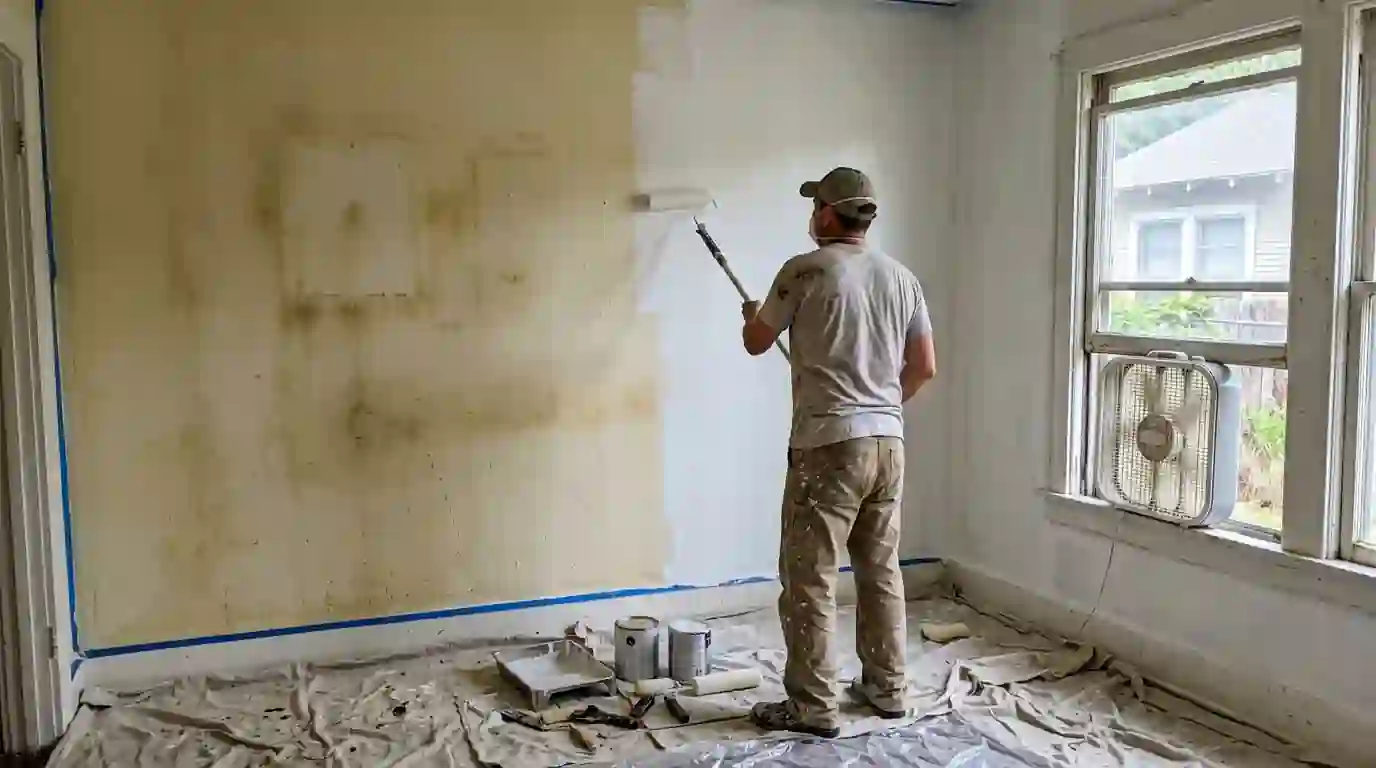
Why nicotine bleeds through new paint
Cigarette smoke leaves a tar and nicotine film that's sticky, yellow-brown and partly water soluble. Latex paint, being water-based, softens that film as it goes on. The stain migrates up into the wet paint and shows as blotchy yellow patches once it dries, sometimes within hours. A second coat of latex usually just spreads the color further. Ceilings tend to look the worst, because smoke rises and the film builds up there first.
The film also gives paint a poor surface to bond to. Paint over a greasy nicotine layer can stay slightly tacky or peel in sheets later. That's why the job always has two parts: removing as much residue as possible, then sealing what's left so it can't reach the topcoat. Skipping either one is what makes smoke-damaged rooms look stained again a few months after a cheap repaint. Both steps take time, and both matter.
Washing the walls before anything else
We start with a degreasing cleaner rated for smoke residue, applied with sponges and microfiber pads from the bottom of the wall upward to avoid streaking, then rinsed. Ceilings usually carry the heaviest film, since smoke rises and collects there. Rinse water running brown is a good sign the cleaner is doing its job; we keep washing until it runs mostly clear. Heavily stained rooms may need two or three washes.
Window sills, door tops, light switches, the top edges of trim and the insides of closets all collect residue too. We clean them in the same pass. Fabric, carpet and HVAC ductwork hold odor as well, and those need separate cleaning by carpet or duct specialists. Sealing the walls handles a big share of the smell, but it can't reach what's in the carpet or air ducts. We'll tell you which ones we notice.
What smoke & nicotine stain sealing typically costs in Fort Worth
$2.15 to $4.35 per square foot
of floor area for walls, ceilings and trim, washed, sealed and repainted in an occupied or empty home. Your price comes from a written scope after we see the job.
What moves the number
- Years of smoking and depth of the yellow film
- Ceilings included, since smoke collects there most
- Shellac-based versus oil-based primer
- Cabinets, doors and trim also needing sealing
- Empty home versus furnished rooms
- Single room versus whole-house treatment
Choosing the right sealer for smoke and odor
For heavy nicotine and lingering smell, we use a shellac-based primer. It dries in under an hour, blocks severe stains and seals odor into the surface. It has a strong smell while wet, so we ventilate well and schedule it in empty rooms or when you can be out. Oil-based stain blockers work well for moderate staining and cost a bit less. They take several hours to dry before topcoating, which stretches the schedule slightly.
Water-based stain-blocking primers have improved, but for real nicotine and smoke odor we stick with shellac or oil. Every wall, ceiling, door and trim surface that was exposed gets a full coat, not just the darkest spots, since residue is everywhere even where it doesn't show. Very heavy ceilings sometimes take two coats of primer before the stain stops showing. Closets and the backs of doors are easy to forget, and they hold odor too.
- Shellac-based primer: heaviest nicotine, strongest odor block
- Oil-based stain blocker: moderate yellowing
- Full coverage on walls, ceilings, doors and trim
- Two primer coats on heavily stained ceilings
After a small kitchen fire or a long-term smoker moves out
Small kitchen fires leave greasy, dark soot that spreads along ceilings and upper walls well beyond the stove. After any fire restoration company has handled cleanup and the area is cleared, we wash remaining residue, seal with shellac primer and repaint. Larger fire damage needs a restoration specialist first, and we come in for the finish work once structural repairs are complete. Grease-heavy kitchen soot needs a stronger degreaser than nicotine film does.
Rental turnovers and estate homes after long-term indoor smoking are the jobs we see most. Landlords want units back on the market quickly, so we wash, seal and repaint in a tight schedule, often coordinating with carpet replacement and duct cleaning. For home sales, sealing smoke odor before listing matters, since buyers notice smell immediately when they walk in. A sealed, freshly painted interior makes a much better first impression at showings and open houses.
Signs it is time for smoke & nicotine stain sealing
- Yellow or brown tint on walls and ceilings that used to be white
- Clean rectangles behind pictures where the wall around them yellowed
- Sticky residue on light switches, door frames and window sills
- Stale smoke smell that returns after cleaning and airing out
- New paint turned blotchy yellow within days of being applied
- Soot shadows on the ceiling above a stove after a small fire
How we handle smoke & nicotine stain sealing, step by step
- 1
Assess residue and odor
We test walls with a damp cloth to see how much film comes off, check ceilings and closets, and note fabrics, carpet and ducts that need separate cleaning.
- 2
Protect and ventilate
Floors and fixtures get covered, outlet covers come off, and we set up fans and open windows so washing and shellac primer fumes clear the space quickly.
- 3
Degrease every surface
Walls, ceilings, trim and doors are washed with a smoke residue cleaner, then rinsed, repeating until rinse water stays mostly clear and surfaces no longer feel tacky.
- 4
Seal with odor-blocking primer
A shellac-based or oil-based primer goes on every exposed surface, with a second coat on heavy ceilings, so stain and smell are locked under the new finish.
- 5
Apply two finish coats
Two coats of quality acrylic paint go over the sealed surfaces, in the sheen and color you choose, with trim and doors finished in a durable enamel.
Fort Worth conditions that shape smoke & nicotine stain sealing
In Fort Worth, a lot of smoke sealing work comes from rental property owners turning units between tenants, from apartment complexes along Loop 820 and I-35W to single-family rentals across Tarrant County. Older homes sold as estates, especially 1960s and 1970s ranches where someone smoked indoors for years, are another common case. Summer heat matters here: closed-up rooms warm quickly in the afternoon, and heat can make lingering odor stronger, so we ventilate well and keep the air conditioning running once primer is dry. If an insurance claim is open after a kitchen fire, check with the adjuster before we start so they can see the soot damage first, and let any fire restoration crew finish its cleanup before the sealing work begins.
Where we offer smoke & nicotine stain sealing around Fort Worth
Across Fort Worth (76102 and surrounding ZIP codes), including Fairmount, Ryan Place, Mistletoe Heights, Arlington Heights, Tanglewood, Westcliff and other neighborhoods, plus these nearby cities and counties:
- Arlington 76010
- Grand Prairie 75050
- North Richland Hills 76180
- Mansfield 76063
- Euless 76039
- Grapevine 76051
- Bedford 76021
- Keller 76248
- Burleson 76028
- Haltom City 76117
- Hurst 76053
- Southlake 76092
- Weatherford 76086
- Saginaw 76179
- Colleyville 76034
- Benbrook 76126
- Tarrant County 76102
- Denton County 76201
- Johnson County 76031
- Parker County 76086