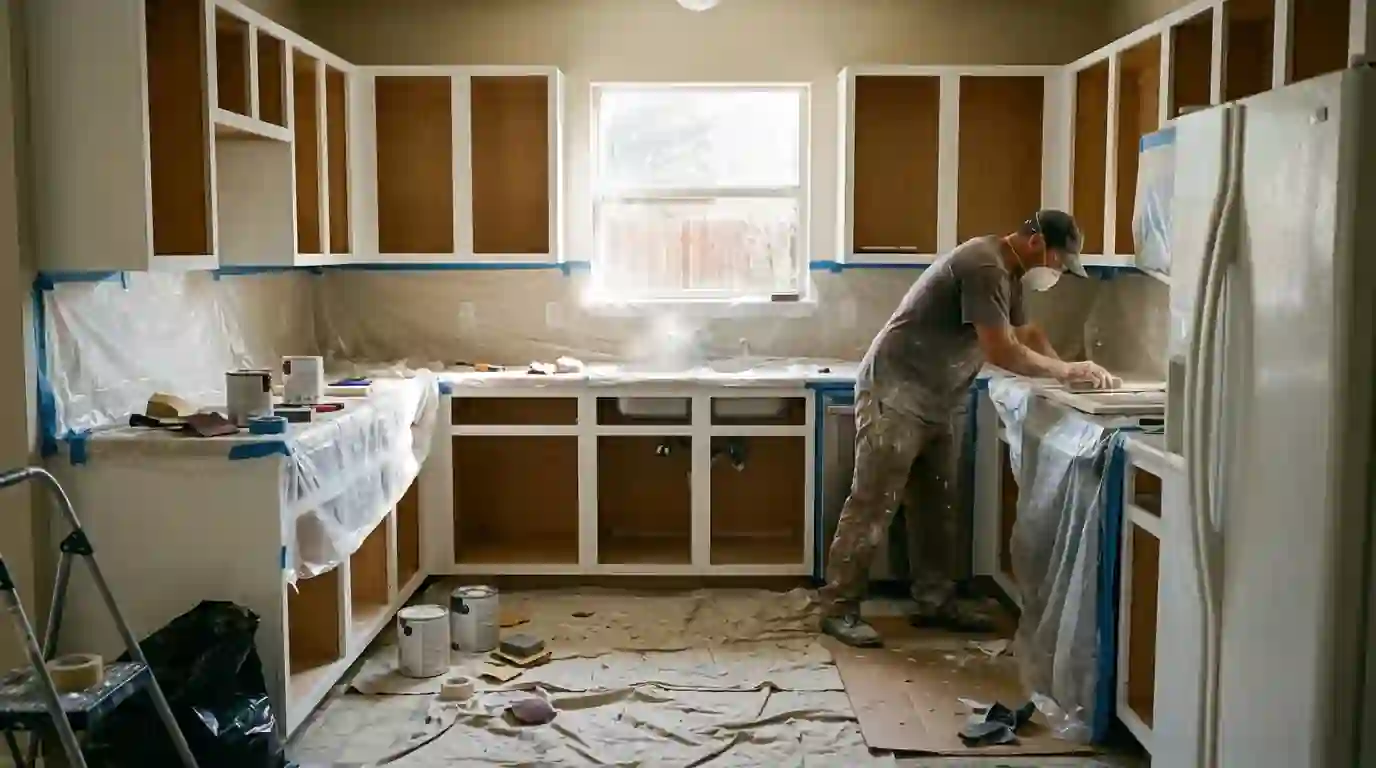
Why degreasing comes before any sanding
Kitchen cabinets near the range, the trash pull-out and the sink carry a film of cooking oil and hand grease that you can't always see. Sanding over that film just pushes the grease into the wood pores, and primer won't bond to it. We wash every door, drawer front and face frame with a dedicated degreaser, rinse with clean water and let everything dry fully. Only then do we scuff sand with 180 to 220 grit, which dulls the old finish enough for primer to grip without cutting through veneer edges. Finally the surfaces are vacuumed and wiped with a tack cloth. Skipping any part of that sequence is the most common reason painted cabinets peel at the handle area within a year.
Which primer and enamel hold up on kitchen doors?
Factory cabinet finishes are slick catalyzed lacquers or conversion varnishes, and ordinary wall primers simply sit on top of them. We use a bonding primer made for glossy surfaces, often a shellac-based primer when the cabinets are stained oak or cherry, because shellac also blocks the tannins that can turn a white finish yellowish pink. For the topcoat we spray a waterborne alkyd or urethane-modified acrylic enamel, such as Sherwin-Williams Emerald Urethane or Benjamin Moore Advance. These level out like an oil paint but clean up with water and don't yellow the way traditional oil does. We apply two finish coats, typically aiming for a total dry film of about 3 to 4 mils over primer. Satin and semi-gloss are the usual sheens, since they wipe clean without looking plastic.
- Shellac-based primer for stained oak, cherry and maple
- Adhesion primer for slick factory lacquer finishes
- Waterborne alkyd or urethane acrylic enamel topcoat
- Satin or semi-gloss for wipeability
What kitchen cabinet painting typically costs in Fort Worth
$3,850 to $7,450
for a typical kitchen with 25 to 35 doors and drawer fronts, boxes painted inside the face frame. Your price comes from a written scope after we see the job.
What moves the number
- Total number of doors, drawers and panels
- Open-grain oak needing grain filler
- Dark stain under a light paint color
- Islands, pantries and bar built-ins
- Glass-front or raised-panel door styles
- Painting cabinet interiors or shelves
Oak grain, and whether you want to see it
A huge share of Fort Worth kitchens built from the 1980s through the early 2000s have red or white oak cabinets with deep open grain. Paint doesn't hide that grain, it highlights it. Some homeowners like the texture, and we leave it. If you want a smooth, modern painted look, we apply a grain filler or a high-build primer to the door faces, sand it back, and repeat where needed. It adds labor, so it's priced as a separate line, but it's the difference between painted oak and a finish that looks like factory painted maple.
Living without a kitchen for a few days
Doors and drawer fronts are labeled, removed and taken to a dedicated spray setup, either a protected garage space or our shop, depending on the job. Cabinet boxes stay in place and are brushed and rolled, or sprayed after we mask the entire kitchen in plastic. Countertops, backsplash, floors and appliances are covered. Most kitchens are usable for basic cooking in the evenings during the box painting phase, and we let you know which day the sink area will be off limits. Doors come back after they've cured enough to handle, typically after several days, and we rehang them, adjust hinges and reinstall hardware, whether that's your original pulls or new ones you've chosen.
How long before painted cabinets are tough enough to use normally?
Cabinet enamels are dry to handle within hours, but they keep hardening for weeks. Most reach a usable hardness in about a week and full cure in three to four weeks. During that period, close doors gently, avoid harsh cleaners, and don't put rubber bumpers back until we've given the go-ahead. After cure, a mild soap and soft cloth is all they need. Keeping a small jar of touch-up enamel handy makes fixing a chip quick.
Signs it is time for kitchen cabinet painting
- Honey oak cabinets that make an otherwise updated kitchen look like 1995
- Peeling paint around handles from a previous brush-on job without primer
- Sticky, darkened finish on doors near the range and trash pull-out
- Mismatched cabinets after a partial remodel or island addition
- Solid wood boxes worth keeping but a style you no longer like
- Preparing a house for sale where the kitchen is the weakest room
How we handle kitchen cabinet painting, step by step
- 1
Label and remove
Every door, drawer front and hinge is numbered to its opening, hardware is bagged, and the kitchen counters, floors and appliances are masked before any cleaning or sanding begins.
- 2
Degrease and scuff
All surfaces are washed with a cabinet degreaser, rinsed and dried, then scuff sanded with 180 to 220 grit and wiped with a tack cloth to remove all dust.
- 3
Prime and fill
A bonding or shellac-based primer goes on, dents and old hardware holes are filled, grain filler is applied if requested, and everything is sanded smooth again.
- 4
Caulk the boxes
Open seams where face frames meet side panels and walls get a flexible paintable caulk, which keeps the painted joints from showing dark lines later.
- 5
Spray finish coats
Doors and drawer fronts are sprayed with two coats of cabinet enamel in a controlled setup, while boxes are finished on site with matching product and technique.
- 6
Rehang and adjust
Cured doors return to their original openings, hinges are adjusted so reveals are even, hardware goes back on and we review every door with you.
Fort Worth conditions that shape kitchen cabinet painting
Fort Worth heat affects cabinet work more than people expect. In summer, a garage used as a spray area can reach well over 100F, which makes enamel dry too fast and leaves texture, so we spray doors early in the day or in a conditioned space and watch humidity during spring storm weeks. Inside the house, foundation movement from the clay soil can twist cabinet runs slightly and open gaps where upper cabinets meet the wall or soffit, so we recaulk those joints rather than paint over the gap. Bright west light through kitchen windows will show brush marks on boxes that look fine in the evening, which is why we finish boxes with a fine-finish roller or spray rather than a brush alone.
Where we offer kitchen cabinet painting around Fort Worth
Across Fort Worth (76102 and surrounding ZIP codes), including Fairmount, Ryan Place, Mistletoe Heights, Arlington Heights, Tanglewood, Westcliff and other neighborhoods, plus these nearby cities and counties:
- Arlington 76010
- Grand Prairie 75050
- North Richland Hills 76180
- Mansfield 76063
- Euless 76039
- Grapevine 76051
- Bedford 76021
- Keller 76248
- Burleson 76028
- Haltom City 76117
- Hurst 76053
- Southlake 76092
- Weatherford 76086
- Saginaw 76179
- Colleyville 76034
- Benbrook 76126
- Tarrant County 76102
- Denton County 76201
- Johnson County 76031
- Parker County 76086