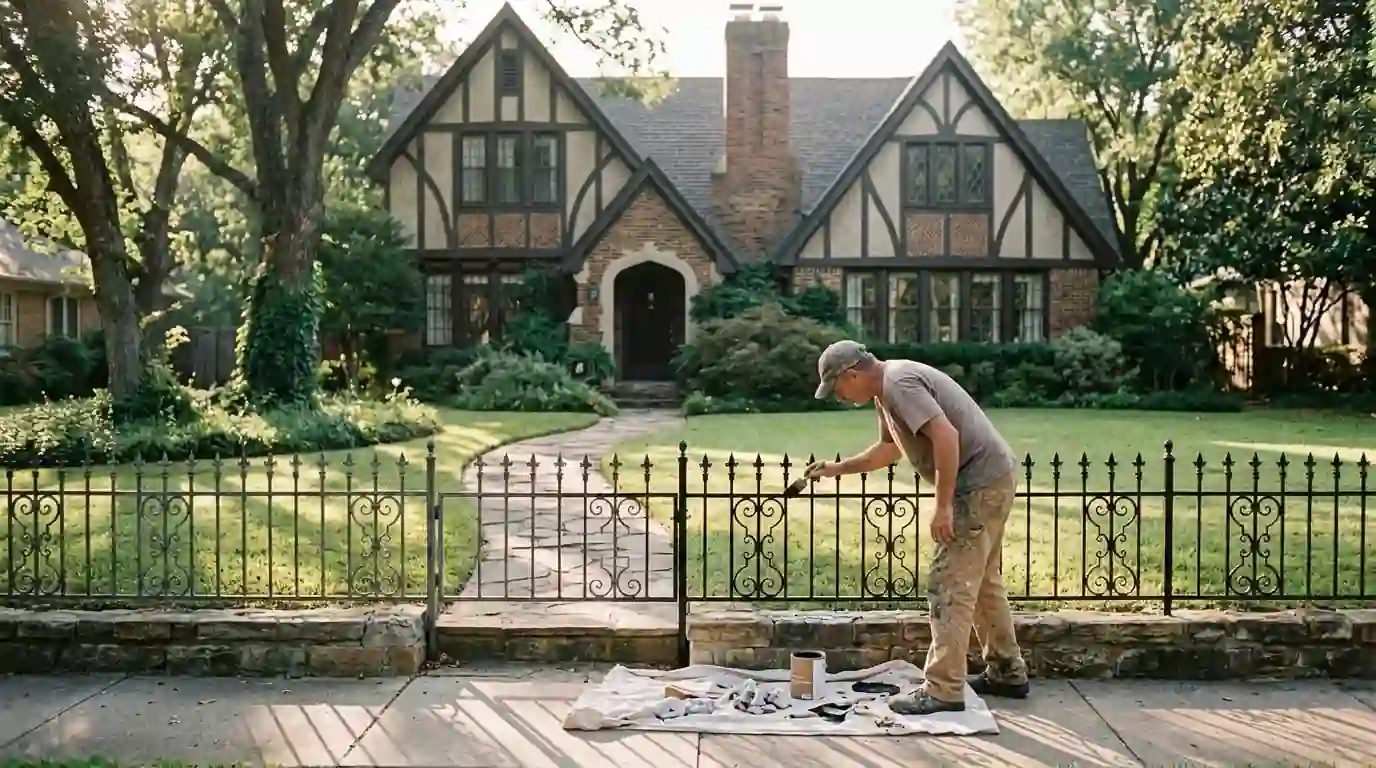
How rust spreads under paint on iron railings
Rust starts wherever bare metal meets moisture, usually at a scratch, a weld, a hail chip or the bottom of a picket where water collects. Once rust starts, it expands and pushes up the surrounding paint, which lets more water in. In Fort Worth, spring humidity, sprinkler spray and morning dew keep iron wet enough to rust steadily, while summer heat bakes the old paint until it's brittle and cracks. Joints between pickets and rails trap water, so rust often appears there first.
Painting over rust without treating it only hides it. The rust keeps growing under the new paint and pops through within a season or two. That's why rust removal and the right primer make up most of the value in this kind of job. A railing that's properly cleaned and primed can hold paint for many years, while a quick spray over flaking rust rarely survives one summer. Proper prep also slows staining on the masonry below.
Removing rust down to sound metal
We start by scraping off loose paint and flaking rust, then use wire brushes, wire wheels on drills and abrasive pads to clean back to sound metal. Heavily rusted areas may need a flap disc or a small grinder, with care around thin pickets and decorative details. Ornate scrollwork gets detail brushes and abrasive cord so we can reach inside curls and corners. Old paint that's still firmly stuck is scuffed so new coats grip, rather than removed entirely.
Any rust that can't be fully removed from pits and crevices is treated with a rust converter, which chemically turns remaining rust into a stable, paintable layer. The metal is then wiped with a degreaser to remove oils, dust and residue. Iron set in concrete or stucco gets extra attention at the base, where rust often eats the metal from the bottom up, and we seal gaps there to keep water out.
- Scrape loose paint and flaking rust
- Wire brush, wheel or grind to sound metal
- Rust converter in pits and crevices
- Degrease before primer goes on
What wrought iron & metal painting typically costs in Fort Worth
$14 to $36 per linear foot
typical range for wrought iron fences and stair or porch railings, not a quote. Your price comes from a written scope after we see the job.
What moves the number
- Linear footage and railing or fence height
- Amount of rust and flaking paint to remove
- Ornate scrollwork, finials and pickets per foot
- Brush application versus spray with heavy masking
- Gates, hinges and latches included
- Second-floor balconies or hard-to-reach stair rails
Which primer and enamel should go on iron?
Bare and converted metal gets a rust-inhibiting primer, either an alkyd metal primer or a direct-to-metal acrylic primer, applied within hours of cleaning so flash rust doesn't appear. For galvanized steel railings, which are common on newer stairs and balconies, we use a primer rated for galvanized surfaces, since some standard primers don't bond well to zinc. Topcoats are either alkyd or urethane-modified enamels, known for hardness and gloss, or direct-to-metal acrylics, which stay flexible and resist chalking in strong sun.
Black satin and semi-gloss are the most common finishes on Fort Worth iron, but bronze, dark green and charcoal are popular too. Darker colors can hide minor surface pitting on older iron. We apply two finish coats so the total film is thick enough to protect edges and corners, where paint naturally runs thin. Handrails get a full cure period before heavy use, since fresh enamel can mark under rings and keys for the first several days.
Brush or spray on fences, gates and balconies
Spraying covers ornate railings quickly and evenly, but it needs heavy masking and very calm wind, since overspray travels far. On iron fences near cars, pools or neighbors, we often brush and use small rollers on flat bars, or spray with shields and drop cloths in close. Brushing also pushes paint into joints and pits better, which helps on older iron. Stair railings next to brick or stucco are usually brushed to avoid overspray on masonry.
Most metal enamels need surface temperatures above 50F and dry weather. Oil-based enamels can take 6 to 24 hours to recoat, while acrylics often allow recoating in a few hours. Iron in direct sun can get extremely hot in summer, so we work it in the morning or when it's shaded. Gates are worked on in sections so you can still use them between coats. Fresh rails are flagged with tape.
Signs it is time for wrought iron & metal painting
- Rust bubbles are lifting paint along fence pickets and rails
- Orange streaks run down onto brick, stucco or concrete below the railing
- Paint is chipping off stair rails where hands grip most
- Gate hinges are rusting and the gate squeaks or sticks
- Iron posts are rusting where they enter concrete
- The black finish has faded to a chalky gray in the sun
How we handle wrought iron & metal painting, step by step
- 1
Survey the metal
We check every section for rust, flaking paint, loose pickets and rusted post bases, confirm whether metal is iron or galvanized steel, and agree on color and sheen.
- 2
Scrape and wire brush
Loose paint and rust are removed with scrapers, wire brushes, wheels and grinders as needed, cleaning back to sound metal, especially at joints, welds and post bases.
- 3
Treat and degrease
Remaining rust in pits is treated with a rust converter, then the metal is degreased and wiped clean so the primer can bond to a clean surface.
- 4
Prime promptly
We apply a rust-inhibiting or galvanized-rated primer the same day as cleaning, before flash rust can start, paying extra attention to edges, welds and the bottoms of pickets.
- 5
Two enamel coats
Two finish coats are brushed or sprayed, depending on location and wind, with recoat times respected so the film hardens properly and fully covers edges and joints.
- 6
Final check and cleanup
We inspect every picket and joint, remove protection from masonry and plants, clean up rust dust and paint chips, and confirm gates swing and latch freely.
Fort Worth conditions that shape wrought iron & metal painting
Wrought iron shows up all over Fort Worth: ornamental fences on older homes in Fairmount and Mistletoe Heights, iron stair and porch railings on 1960s ranches, pool fences across the suburbs, and steel railings on apartment balconies and commercial stairs. Our spring storms, humid stretches and daily sprinkler cycles keep metal wet often enough for rust to grow, while the summer sun bakes paint until it cracks. Hail can chip paint on exposed railings. Iron set into concrete steps and stucco walls tends to rust at the base, staining masonry orange. We treat these spots carefully, seal the joints, and schedule summer metal work for cooler mornings so coatings cure evenly.
Where we offer wrought iron & metal painting around Fort Worth
Across Fort Worth (76102 and surrounding ZIP codes), including Fairmount, Ryan Place, Mistletoe Heights, Arlington Heights, Tanglewood, Westcliff and other neighborhoods, plus these nearby cities and counties:
- Arlington 76010
- Grand Prairie 75050
- North Richland Hills 76180
- Mansfield 76063
- Euless 76039
- Grapevine 76051
- Bedford 76021
- Keller 76248
- Burleson 76028
- Haltom City 76117
- Hurst 76053
- Southlake 76092
- Weatherford 76086
- Saginaw 76179
- Colleyville 76034
- Benbrook 76126
- Tarrant County 76102
- Denton County 76201
- Johnson County 76031
- Parker County 76086